
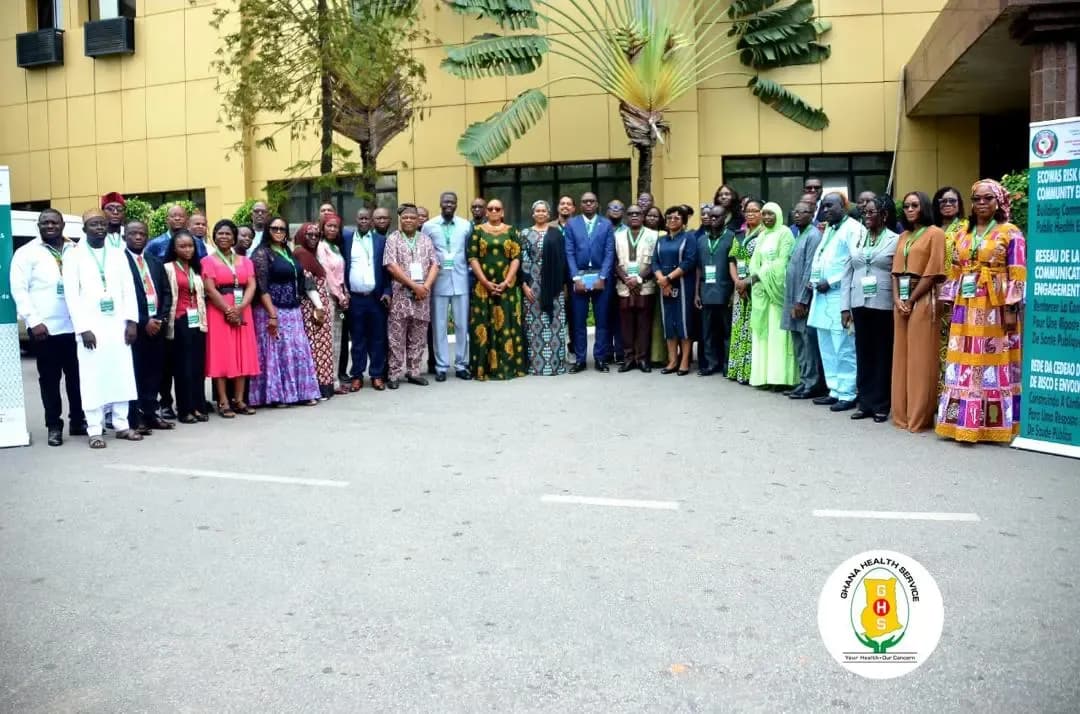
Ghana joined the ECOWAS Regional Centre for Surveillance and Disease Control at a 3-day regional workshop on capacity building for Risk Communication and Community Engagement this week in Abuja, Nigeria.
The workshop brought together member states of the ECOWAS community that are part of the RCSDC to share ideas and expertise on health issues, especially the current Ebola outbreak in some African countries. The workshop also provided the opportunity to strengthen the capacity of members of the RCSDC and build on operational mechanisms already in place.
Dr. Moussa Soumah, President of the ECOWAS Regional RCCE Network, welcomed the participants. He reminded attendees that Risk Communication and Community Engagement is a fundamental pillar of health security. He encouraged Member States to strengthen their ownership of RCCE, particularly through the mobilisation of national resources and the establishment of a dedicated budget line and called on partners to continue their support.
Dr. Babacar FALL, representing the Executive Director of the ECOWAS Regional Centre for Surveillance and Disease Control, emphasised that Risk Communication and Community Engagement is a central component of preparedness and response to public health emergencies, particularly in the face of challenges related to misinformation and the threat of Ebola virus disease. He noted that the workshop would provide an opportunity to assess countries’ capacities, update the network’s strategic documents, and strengthen regional cooperation. He encouraged participants to formulate concrete recommendations to strengthen national RCCE systems.
Dr. Tochi Okwor, representing the Minister of Health of Nigeria, reaffirmed Nigeria’s commitment to strengthening regional health security. She stressed that infectious diseases recognize no borders and that Risk Communication and Community Engagement is essential for an effective response. She commended the role of the RCSDC and technical partners in strengthening the capacities of Member States, while calling for communities to be placed at the center of interventions.
Mrs. Fatima Hussainai ZANNA, Disease Prevention Officer with the GIZ-RPPP Epidemic Prevention Project, commended the strong participation of Member States and reaffirmed GIZ’s commitment to supporting capacity strengthening in Risk Communication and Community Engagement across the region. She encouraged participants to share experiences, strengthen regional collaboration, and improve preparedness for public health emergencies.
The 3-day workshop ended with the election of new executives for the RCSDC.
Da Silva Estevão of Guinea-Bissau was elected President, while Patrick Lansana of Sierra Leone was elected Vice President. Paul Alle Kouadio of Côte d'Ivoire was elected General Secretary, with Kpogbeme Pricile of Benin and Hannatu Bello of Nigeria elected as First and Second Assistant Secretaries, respectively.
Newly elected executives were encouraged to be resilient and were assured of the support of outgoing executives and members of the network.