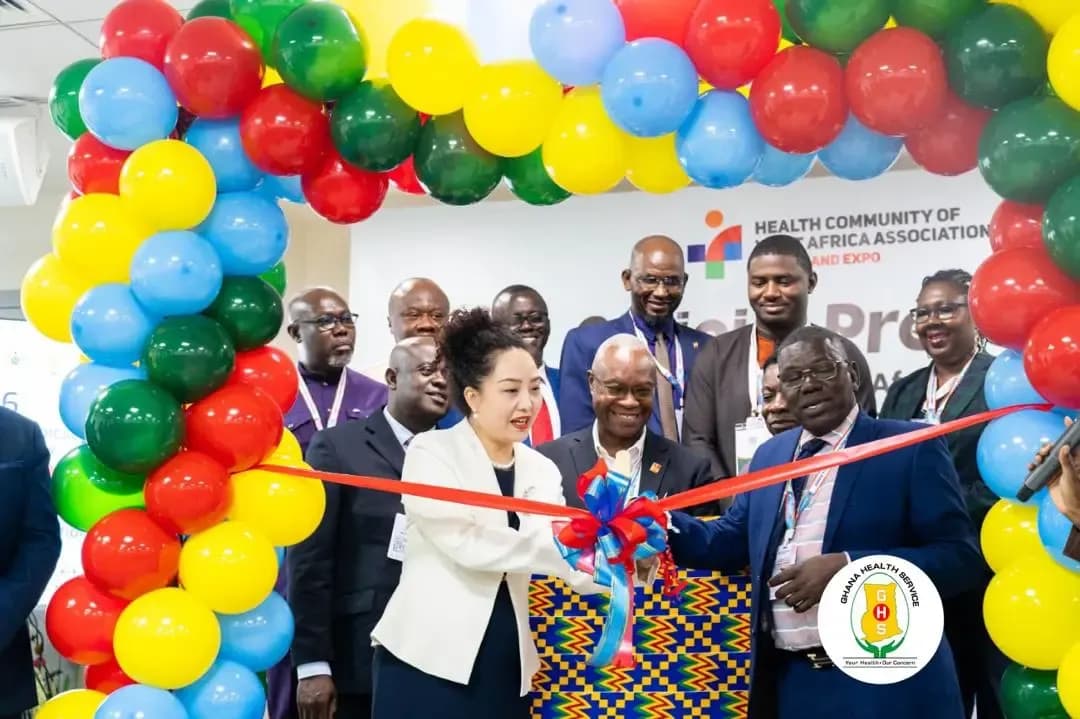
Ghana is set to host the 3rd China-West Africa Medical & Health Industry and AI Diagnosis & Project Co-operation Summit and Expo 2026, from 19th to 21st August 2026, at the Ghana International Mall in Accra.
The official press launch of the Summit was held under the theme, “Strengthening China-West Africa Health Partnerships through Innovation, Investment, Technology and Sustainable Healthcare Development.”
The event is being organised by the Health Communities of West Africa Association (HCOWA), with support from the Ghana Health Service as a platform to assemble governments, health institutions, technology companies, investors, medical practitioners, researchers and other stakeholders to explore opportunities for strengthening healthcare systems through technology, investment and international cooperation.
The press launch brought together a wide array of government officials, diplomats, business executives, captains of industry, medical practitioners, alternative medicine practitioners and the media.
Delivering the keynote address on behalf of the Minister of Health, Dr Hafiz Adam Taher, Director-Technical Coordination at the MOH, described the Summit as the beginning of an exciting new chapter in Ghana-China health partnerships and commended HCOWA for choosing Ghana as the host country.
He said the initiative was aligned with the Ministry's commitment to promoting human-centred approaches to healthcare delivery, stressing that Ghana could not afford to miss out on the opportunities presented by AI and other emerging technologies.
Dr Taher also noted that the Free Primary Health Care (FPHC) initiative, which seeks to remove financial barriers to accessing primary healthcare, would require complementary technological innovations to strengthen disease surveillance, diagnosis and treatment. However, he emphasised the need for AI and other emerging technologies to be deployed responsibly, with strong attention to ethical standards, safety and appropriate governance.
Dr. Taher noted that the high level of international participation in the Summit was a testament to Ghana's growing influence and impact within the West African subregion and he encouraged managers of health facilities, health professionals across all cadres and industry leaders to actively participate in the Summit and Expo to explore opportunities for collaboration, innovation and investment, while reaffirming the Ministry's commitment to initiatives that advance innovation and technology in healthcare and formally invited the public and stakeholders to participate in what he described as a historic gathering.
He said AI had the potential to improve diagnostic accuracy, support clinical decision-making, enhance disease surveillance, optimise resource allocation and expand access to quality healthcare, particularly for underserved and remote communities.
Speaking on behalf of the Greater Accra Regional Minister, Hon. Linda Akweley Ocloo, the Director of the Greater Accra Regional Health Directorate of the Ghana Health Service, Dr. Robert Amesiya, highlighted the longstanding and healthy relations between Ghana and China, while touting the strategic importance of the Greater Accra Region to Ghana's economy and healthcare delivery, adding that despite various interventions, significant gaps continued to exist within the health system.
Dr. Amesiya expressed the belief that the adoption of AI and other emerging technologies could help bridge some of these gaps by expanding access to healthcare, improving specialised care and strengthening diagnostic infrastructure.
He also stressed the importance of technology transfer, noting that Ghana must be positioned not only to acquire medical equipment but also to build, operate, maintain and adapt such technologies to meet the country's specific healthcare needs.
Joining the press launch via a video message, the Director-General of the Ghana Health Service, Dr. Samuel Kaba Akoriyea, noted that Artificial Intelligence (AI) was no longer a concept for the future but an essential tool for modern healthcare delivery.
He stressed that AI had the potential to improve diagnostic accuracy, support clinical decision-making, enhance disease surveillance, optimise resource allocation and expand access to quality healthcare, particularly for underserved and remote communities, and subsequently threw an invitation to relevant stakeholders to participate in the summit and exposition.
In a related speech, the President of HCOWA, Madam Jiang Sihong, said the organisation envisions contributing to making Ghana a hub for healthcare and medical technology in the West African subregion, explaining that the Summit would create a platform for governments, health institutions, investors and other stakeholders to explore opportunities for collaboration and investment aimed at improving health systems and outcomes.
Presenting an overview of HCOWA, Vice President, Mr Prince Opoku Dogbey, hinted that the organisation was exploring opportunities to establish pharmaceutical production facilities, technology transfer centres, academic exchange programmes, as well as investment and trade partnerships; initiatives aimed at strengthening Ghana's healthcare ecosystem and positioning the country as a regional hub for medical technologies.
He also shared experiences and lessons from previous editions of the Summit, highlighting the growing opportunities for collaboration between Ghana and China in the health and medical technology sectors.