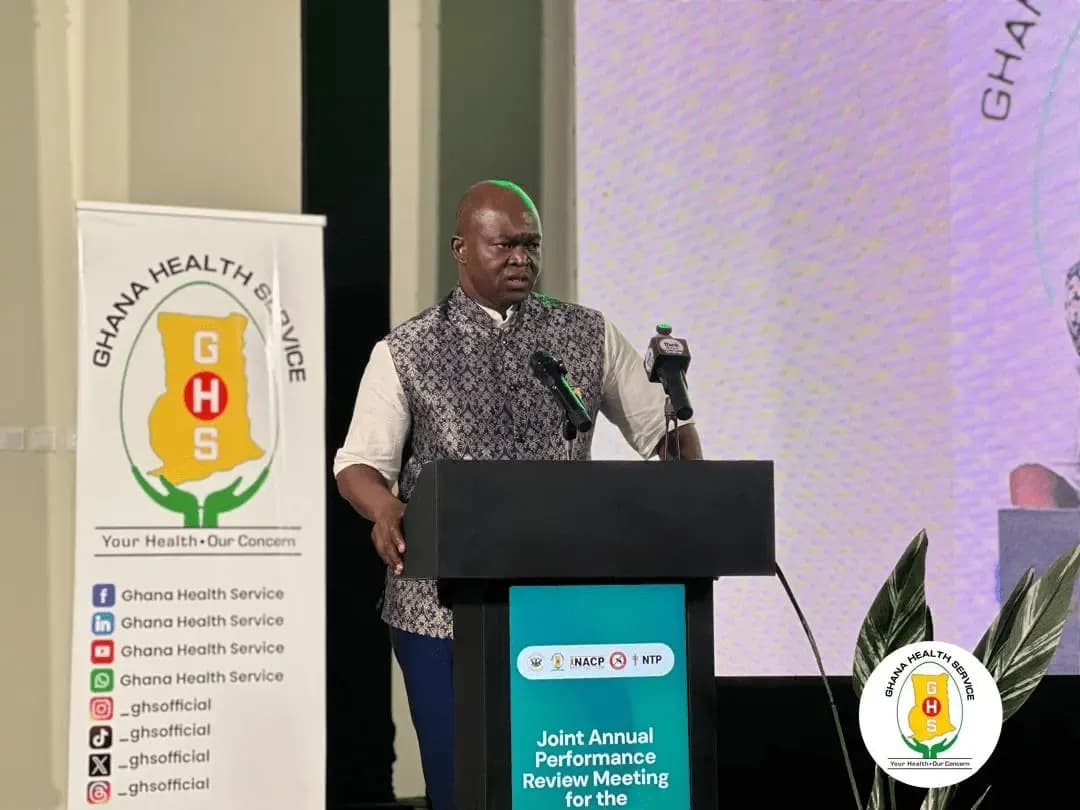
The Ghana Health Service (GHS) held a Joint Annual Performance Review Meeting that brought together stakeholders from three major national disease control programmes, the National AIDS Control Programme (NACP), the National Tuberculosis Programme (NTB), and the National Malaria Elimination Programme (NMEP), to assess progress and strengthen strategies for improved health outcomes in Ghana. The meeting was held under the theme; “Strategic Reprioritization for Maximum Impact”.
Delivering the keynote address, the Director-General of the Ghana Health Service, Dr. Samuel Kaba Akoriyea, emphasized the importance of viewing the country’s health system as an integrated structure rather than isolated programmes. He explained that diseases do not occur in isolation and therefore responses to them must also be coordinated and integrated.
Using maternal health as an example, the Director-General noted that addressing complex health challenges often requires collaboration across multiple medical specialties such as intensive care, radiology, surgery and rehabilitation, demonstrating the importance of a strong and coordinated health system.
He stressed that integration across the National AIDS Control Programme, the National Tuberculosis Programme, and the National Malaria Elimination Programme is critical for achieving sustainable health outcomes, explaining that patients often experience multiple health conditions simultaneously, which makes it necessary for health services to address diseases collectively rather than separately.
Dr. Akoriyea further emphasized that as global health financing continues to evolve, Ghana must focus on improving efficiency, accountability and local leadership in managing health programmes. He therefore called on Regional, Metropolitan, Municipal and District Health Directors to take ownership of programme performance and ensure that health data is effectively used to inform decision-making.
He also urged health leaders to strengthen tuberculosis screening at health facilities and integrate HIV services into routine healthcare delivery. While acknowledging Ghana’s progress in reducing malaria mortality, noted that achieving malaria elimination will require sustained commitment and stronger domestic resource mobilization.
The Director of Public Health Division, Dr. Franklin Asiedu-Bekoe, highlighted the importance of the joint review in strengthening collaboration across disease control programmes. He commended programme managers for successfully organizing the first combined performance review of the three programmes and noted that the initiative aligns with global health funding expectations that encourage stronger integration and coordination across disease programmes.
He explained that the review meeting aimed not only to assess programme performance but also to identify challenges and opportunities for improvement.
Dr. Asiedu-Bekoe further stressed the need to integrate resources and interventions across programmes to maximize impact and ensure the efficient use of available funding. He also underscored the importance of improving data quality, strengthening partnerships and enhancing collaboration among stakeholders to sustain progress in the fight against HIV, tuberculosis and malaria.
The Director of the Institutional Care Division at GHS, Dr. Lawrence Ofori-Boadu, reaffirmed the need to strengthen collaboration between public health and clinical services to improve service delivery nationwide. He noted that closer coordination between public health units and healthcare facilities would significantly enhance disease prevention, detection and management.
Dr. Ofori-Boadu also stressed that strategic prioritization of activities is essential to ensure that limited resources are directed toward high-impact interventions. He added that empowering frontline health workers, strengthening behavioral change interventions and improving disease surveillance systems remain critical to improving health outcomes.
Representatives from the Country Coordinating Mechanism (CCM) Ghana also addressed participants and highlighted the need for strategic reprioritization of resources in response to potential reductions in global health funding. They noted that Ghana continues to benefit from investments from the Global Fund to support HIV, tuberculosis and malaria programmes, while emphasizing the importance of efficient resource utilization and stronger domestic financing to sustain progress. Participants were therefore encouraged to prioritize sustainability, service integration and domestic resource mobilization to ensure the long-term continuity of essential health programmes.
Delivering the closing remarks on behalf of the Director-General, the Director of Public Health Division, Dr. Franklin Asiedu-Bekoe, expressed appreciation to local and international partners, regional health directorates, district health teams, civil society organizations and other stakeholders for their continued support and collaboration.
He noted that although the past year presented several challenges, the progress made demonstrates that meaningful results can be achieved through sustained commitment, teamwork and effective collaboration.
Looking ahead, he encouraged all the stakeholders to work towards improved strategies and renewed direction in the coming year to enhance health service delivery nationwide.