
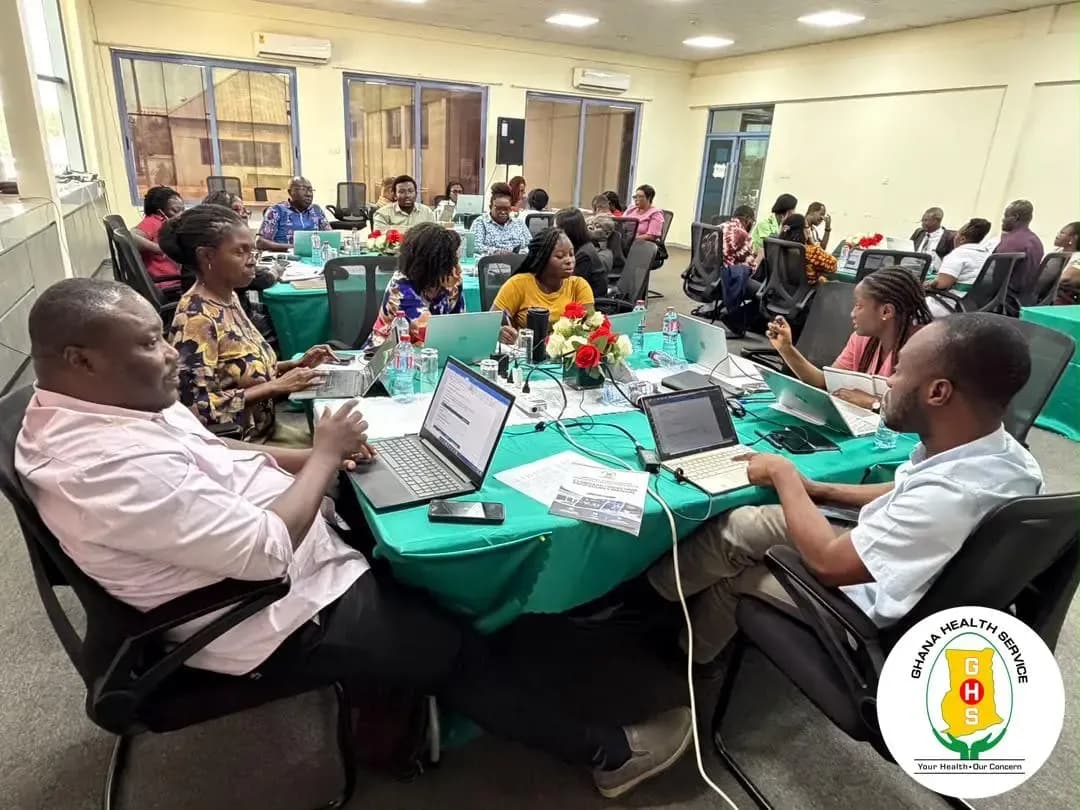
The Ghana Health Service (GHS), through the Public Health Emergency Operations Centre (PHEOC), held a two-day validation workshop on the Public Health Workforce Surge Training Package from 9–10 September 2026 at the GHS Head Office Conference Room, Pantang, Accra. The workshop aimed to ensure that the package is technically sound, practical and suitable for preparing a competent and deployment-ready workforce for public health emergencies.
The workshop brought together representatives from the Ministry of Health, GHS divisions, departments and regional structures, National Disaster Management Organisation (NADMO), National Ambulance Service (NAS), Ghana Police Hospital, 37 Military Hospital, Veterinary Services Directorate (VSD), Environmental Protection Authority (EPA), National Development Planning Commission (NDPC), academia, development partners and other government institutions and agencies. The broad representation reflected the multisectoral and One Health approach required for effective public health emergency preparedness and response.
Opening the workshop on behalf of the Director-General of the Ghana Health Service, the Director of Public Health, Dr Franklin Asiedu-Bekoe, underscored the importance of maintaining a well-prepared and deployment-ready workforce that can be rapidly mobilised when emergencies exceed routine capacity. He noted that effective workforce surge requires the ability to identify workforce gaps, mobilise personnel with the right competencies and manage them effectively throughout the deployment lifecycle.
Dr Asiedu-Bekoe acknowledged the US Centers for Disease Control and Prevention (US CDC), Korea International Cooperation Agency (KOICA), African Field Epidemiology Network (AFENET), World Health Organization (WHO), and other partners for their technical, financial and broader support to the initiative and Ghana's public health emergency preparedness and response efforts. He also thanked participating institutions and technical experts for their contributions and recognised the significant work undertaken so far in developing the workforce surge system and training package.
In separate remarks, development partners reaffirmed their commitment to strengthening Ghana's public health workforce readiness. Speaking on behalf of US CDC, Dr Michael Adjabeng highlighted the importance of strengthening sustainable systems and competencies for the timely mobilisation and deployment of personnel during emergencies. Alice Sallar Adams, representing AFENET, commended the collaborative approach to developing the package and reiterated AFENET's continued support for strengthening public health emergency preparedness and workforce surge capacity in Ghana.
Presenting an overview of the package, the Head of the Public Health Emergency Operations Centre, Dr Lawrence Lartey, explained that the training translates the National Public Health Workforce Surge Strategic Plan, 2026 and the approved National Public Health Workforce Surge Standard Operating Procedures, Volume II – WS-SOP Series into the knowledge, skills and practical competencies required for implementation. He emphasised that the competency-based approach moves beyond theoretical knowledge to focus on what participants can apply and demonstrate during public health emergencies.
Over the two days, participants worked in groups to review the curriculum, training presentations, practical scenarios and exercises, facilitator guidance, assessment tools and participant job aid. The package was cross-checked against the Strategic Plan and approved SOPs. Participants presented and cross-reviewed their findings and agreed on revisions to strengthen the package's technical consistency, practicality and usability.
The validation workshop concluded with agreed recommendations to refine and finalise the Public Health Workforce Surge Training Package. The revisions will be incorporated ahead of the planned five-day Training of Trainers programme, which will prepare facilitators to support standardised national and subsequent cascade training.