The Director-General of the Service, Dr. Samuel Kaba Akoriyea, has announced that schools, churches and mosques across the country have been mapped within Community-based Health Planning and Services (CHPS) zones to serve as centres for monthly health education under the Government's flagship Free Primary Healthcare (FPHC) Initiative.
The initiative, he explained, forms part of a comprehensive strategy to strengthen preventive healthcare through monthly community durbars, household visits and sustained health promotion activities aimed at bringing quality healthcare closer to the people.
Elaborating further on the Free Primary Healthcare, he mentioned that, home visits will become routine, out of the 5 days within the week, 3 days are for home visits, the fourth day shall be used for clinical work at the health facility level, while the fifth day will be for outreach services including community durbars and vaccination campaigns amongst others.
The patient navigator (a visiting nurse) shall book and coordinate appointments for patients to the next level with feedback follow up to the households. This referral system will decongest higher level facilities, reduce waiting time and in part the no bed syndrome.
He added that the re-mapping of CHPS compounds and zones has facilitated the inclusion of the schools, churches and mosques within specific CHPS zones. Community nurses shall therefore extend services to the schools within their zones while preventive and promotion activities shall take place at least once in a month in churches and mosques and any other community pillar that is appropriate for health sensitization.
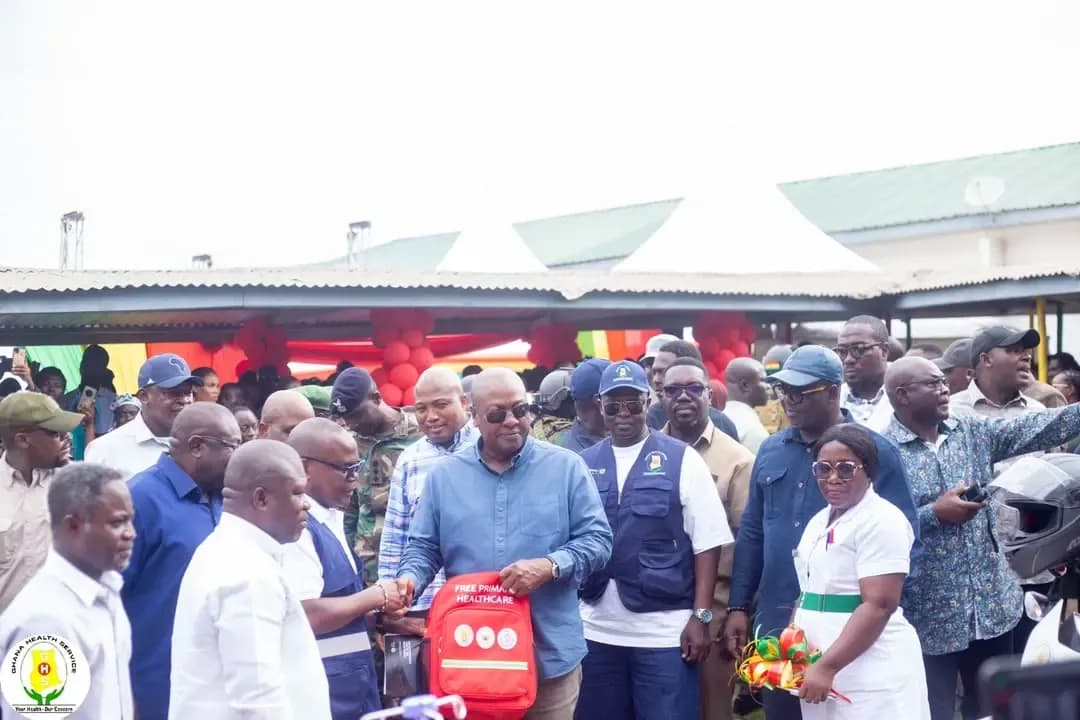
Speaking at the Free Primary Healthcare durbar held at the Ho Municipal Hospital during President John Dramani Mahama's working visit to the Volta Region, he noted that the Ghana Health Service has already distributed essential medical equipment to community volunteers, community health nurses, CHPS compounds, health centres and polyclinics across the country to support the smooth implementation of the initiative.
Dr. Akoriyea described the programme as a bold step towards ensuring equitable access to healthcare for all Ghanaians, particularly those living in underserved communities and assured the President that the Ghana Health Service fully appreciates the significance of the initiative and remains committed to translating the President's vision into measurable improvements in the health and well-being of Ghanaians.
H.E John Dramani Mahama, in his keynote address, commended the Ho Municipal Hospital for its century of dedicated service to the people of the municipality as the facility celebrates its 100th anniversary this year.
He described health as one of life's greatest treasures, noting that people often appreciate its true value only when illness strikes. He reaffirmed government's commitment to strengthening Ghana's healthcare system and improving the welfare of health professionals, assuring nurses and other healthcare workers that their conditions of service would continue to improve as the economy recovers.
The President announced that government has granted financial clearance for the recruitment of 16,000 health workers, to be undertaken in two phases of 8,000 each, to address the backlog of qualified professionals awaiting posting. He said a significant proportion of the newly recruited personnel would be deployed to underserved communities to bridge the gap in healthcare delivery across the country.
He urged the incoming health workers to embrace the spirit of service exemplified by Florence Nightingale, reminding them that the nursing profession demands sacrifice, compassion and a willingness to serve wherever they are posted. He also reminded all health professionals of the oath they took to provide competent and compassionate care at all times, encouraging them to set aside personal challenges while attending to patients and to treat every individual with dignity and empathy.
President Mahama explained that the Free Primary Healthcare Initiative forms a critical pillar of government's efforts to achieve Universal Health Coverage by removing financial barriers to essential healthcare services at the primary level. He said the initiative is particularly targeted at people in rural and underserved communities who are not enrolled on the National Health Insurance Scheme (NHIS) and who rely primarily on CHPS compounds for their healthcare needs.
He encouraged all Ghanaians to adopt preventive healthcare practices by visiting a health facility at least once every year for routine medical examinations, stressing that early detection remains one of the most effective ways of preventing serious illnesses and reducing healthcare costs.
As part of efforts to curb the growing burden of non-communicable diseases, the President also advised Ghanaians to adopt healthier eating habits by consuming heavier meals during the day and lighter meals in the evening.
He further announced government's continued investment in specialised healthcare infrastructure, revealing that two new cardiothoracic centres are being constructed at the Komfo Anokye Teaching Hospital and the Tamale Teaching Hospital, while additional centres are expected to be established in Ho and Takoradi next year to improve access to specialist cardiac care across the country.
In his remarks, the Minister for Health, Hon. Kwabena Mintah Akandoh, reiterated the critical role of primary healthcare in achieving Universal Health Coverage (UHC), noting that countries that have successfully attained UHC have done so through deliberate and sustained investment in primary healthcare systems.
Hon. Akandoh stated that government has not only rolled out the policy but has also made the necessary investments to ensure its successful implementation. He disclosed that approximately 24,000 pieces of medical equipment have been procured for distribution to health facilities nationwide, describing the exercise as one of the largest retooling efforts in the country's health sector.
The Minister further revealed that the Ministry is considering a range of incentives to encourage health professionals to accept postings to rural and underserved communities. These include accelerated promotions, financial and non-financial incentives, scholarships, and expanded opportunities for post-basic specialist training in areas such as oncology and critical care nursing. He noted that some of these specialist training programmes have already commenced at the Komfo Anokye Teaching Hospital and the Tamale Teaching Hospital.
He also announced that about 30 tutors from nursing training institutions are being sponsored to pursue PhD programmes to strengthen faculty capacity and improve the quality of training for the country's future health workforce.
The Free Primary Healthcare Initiative, launched in April 2026, is a flagship government intervention designed to shift Ghana's healthcare system from a predominantly curative approach to one that prioritizes preventive healthcare. Through regular health education, community outreach, home visits, health screening and early detection of diseases, the initiative seeks to empower individuals to take charge of their health while reducing the burden of preventable illnesses. It is expected to strengthen primary healthcare delivery, improve health outcomes, and accelerate Ghana's progress towards achieving Universal Health Coverage.