
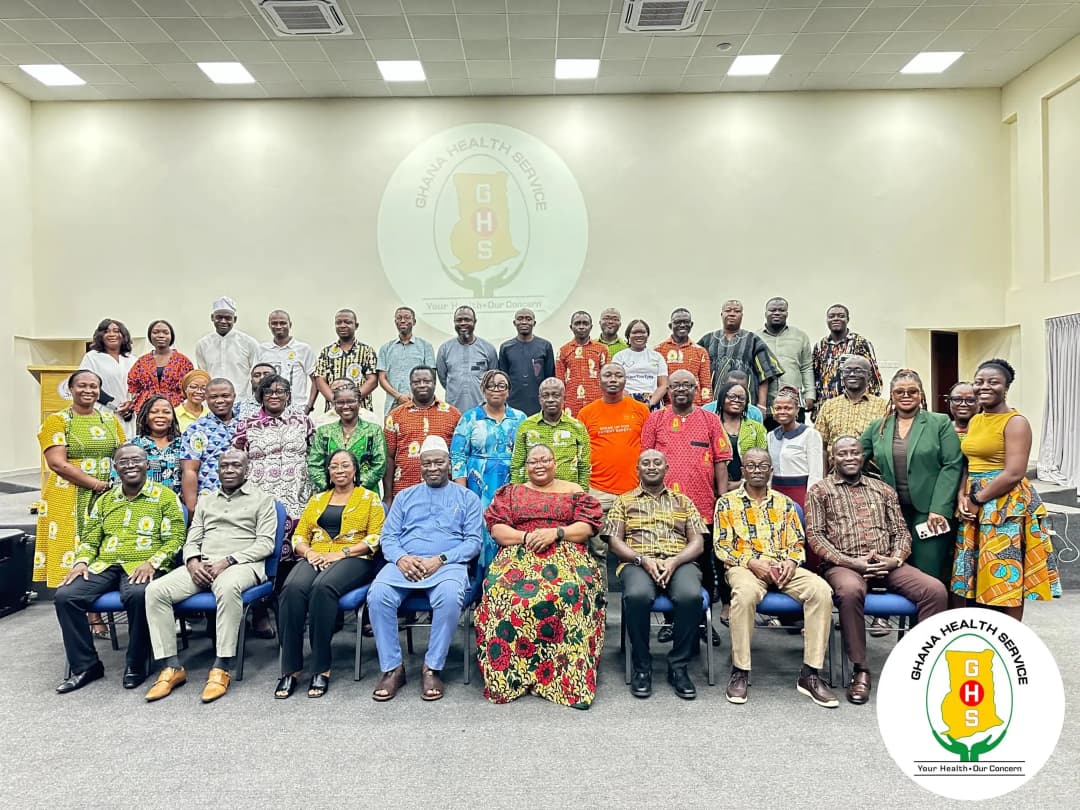
The Policy, Planning, Monitoring and Evaluation Division of the Service has held an orientation meeting for members of the GHS Council, Directors and staff of Headquarters to deepen understanding of the Free Primary Health Care (FPHC) programme and strengthen coordination for its implementation.
Held at the Prof. Agyeman Badu Akosa Conference Room of the new GHS Headquarters in Pantang, the meeting provided an opportunity for management and staff to review the progress of FPHC implementation, understand the roles of the various divisions and departments, and discuss emerging issues requiring coordinated action.
The orientation comes as FPHC is being implemented in 135 districts across all 16 regions, covering 4,447 facilities. Training for District and Sub-district teams across the regions was completed by 5 September 2026, while health kiosks are also being established to extend access to essential services in underserved communities.
Delivering the welcome address and purpose of orientation on behalf of the Director-General of the Service, Dr. Samuel Kaba Akoriyea, the Deputy Director-General, Dr. Caroline Reindorf Amissah explained that the initiative seeks to strengthen primary healthcare as the foundation of the health system while removing barriers that prevent people from accessing essential services.
The Deputy Director-General further added that free healthcare must go beyond removing payment at the point of care. It must also mean taking services closer to communities, strengthening health promotion and disease prevention, improving early detection and creating systems that allow clients to move smoothly through the health system when referrals are required.
Dr. Amissah noted that the orientation was intended to create a common understanding among leadership and Headquarters staff so that every division could appreciate its role in translating the policy into practice.
She emphasized that the success of FPHC would not be determined merely by policies, guidelines or meetings, but by the experience of the Ghanaian who walks into a health facility and receives the care needed without cost becoming a barrier.
Taking participants through an overview of the implementation of the FPHC, the Director for Policy, Planning, Monitoring and Evaluation Division (PPMED), Dr. Samuel K. Boakye-Boateng, highlighted the importance of strong coordination, continuous learning, effective oversight and evidence-based decision-making as the programme expands.
He noted that implementation was already generating important lessons from communities and facilities, making monitoring and learning essential to improving the programme as it progresses.
The presentation also reinforced the need for all levels of the health system to work together, from national leadership through the regions and districts to the community level.
Explaining the financial architecture of the FPHC implementation in the Service, the Director of Finance, Mr. Mustapha Hamidu, indicated that while the programme builds on existing financing mechanisms, an important innovation is the introduction of population-based funding to support promotive and preventive services.
Mr. Hamidu further emphasized the need for transparency, proper utilization of funds and the need to ensure that resources reach the activities and communities for which they are intended.
Dr. Franklin Asiedu-Bekoe, Director for the Public Health Division, in his presentation on Service Delivery Implementation for Free Primary Health Care, highlighted that Free Primary Health Care is focused on bringing essential healthcare closer to communities through free, preventive and promotive services. He noted that through household and community visits, health workers will provide health education, conduct early detection of diseases, support immunization and other essential services, and refer clients when necessary.
Representing the Director of the Institutional Care Division, Dr. Lawrence Ofori Boadu, Dr. Ebenezer Oduro Mensah, Deputy Director for clinical care at ICD, stressed on strengthening standards, guidelines and protocols for safe and consistent service delivery under the FPHC.
He highlighted the importance of standardizing care across different levels and ensuring that health workers have the guidance and resources required to make sound decisions at the point of service.
Taking participants through the Home Visits Checklist and Patient Navigation within the FPHC Framework, the Director for Nursing and Midwifery Services, Dr. Eva Mensah, demonstrated how home visits are being structured to ensure that healthcare workers do more than simply visit households.
Adding that health workers are expected to assess, educate, identify health risks, provide appropriate interventions, document findings and, where necessary, connect clients with further care.
She further stated that the newly developed home visit checklist is structured around different modules and is designed to support comprehensive and standardized assessments based on the needs of individual households. The approach, she said, incorporates planning, respect for households, personal safety, privacy and confidentiality, health education, documentation, referral and follow-up.
Dr. Mensah further explained that the emerging patient navigation system is designed to ensure that a referral does not become the end of a client's journey. Instead, the system creates a bridge between the community and the health facility, helping clients navigate referrals, appointments, follow-up and continuity of care.
She noted that the patient navigation component is supported by a digital platform developed in collaboration with the IT Department, with the aim of ensuring that clients do not get lost between one level of care and another.
Speaking on supply chain implementation with a particular focus on equipment distribution, the Director for Supplies, Stores and Drugs Management, Mrs. Araba Kudiabor, explained the work undertaken to procure and distribute equipment to beneficiary facilities, including the movement of equipment from the central medical stores to regions and onward to facilities.
She highlighted the distribution of home visit kits to support community-level service delivery and the measures being undertaken to ensure the availability of the equipment required for FPHC service delivery. She also addressed the availability and distribution of essential commodities, noting the role of existing supply chain systems in ensuring that these commodities reach the facilities where they are needed.
Speaking on Community Engagement and Demand Generation for FPHC, the Director of Health Promotion, Mrs. Mabel Asafo-Kisiwaa, highlighted the importance of sustained communication, public education and community engagement in creating awareness about the programme and encouraging communities to make use of available services.
She outlined the use of multiple communication channels, including social and traditional media, radio and television discussions, interpersonal communication and accessible communication materials, including approaches that respond to the needs of persons with disabilities. She also highlighted the importance of engaging traditional, religious and other community leaders as champions of the programme and equipping health workers with the skills to communicate effectively with the communities they serve.
The FPHC Programme Coordinator at the Ghana Health Service, Dr. Salamatu Attah Nantogma, presented on Data Management, Monitoring, Evaluation and Sustainability, highlighting the role of data in tracking implementation and informing decisions to improve the programme.
She explained that monitoring is underway across areas including coverage, facility readiness, service delivery, workforce, referrals, medicines, financial accountability and community-level activities. She also highlighted the need to strengthen the integration and interoperability of existing data systems to support timely access to information and response to emerging implementation challenges.
On sustainability, she highlighted the importance of continued leadership support, institutional ownership, advocacy, community engagement and the identification of champions at the national, regional and district levels.
In outlining the next steps, the Director of PPMED, Dr. Samuel K. Boakye-Boateng, reminded participants to take the knowledge gained back to their respective divisions, regions and structures, strengthen internal coordination and continue working towards a shared understanding of the programme.
He emphasized the need for divisions and departments to translate the orientation into coordinated action as implementation progresses, with each part of the Service contributing to the delivery of FPHC.
Delivering the closing remarks on behalf of the GHS Council, Dr. Gina Teddy commended the various divisions, departments and units for the tremendous effort invested in getting the FPHC programme to be implemented within a relatively short period.
She acknowledged that FPHC was still a developing and evolving programme and encouraged continued dialogue, evidence generation and constructive feedback to help strengthen its implementation.
She stressed the importance of leadership, policy, regulation, resources and institutional support in sustaining the programme, while assuring the implementation teams of the continued support of the Council.
She noted that as implementation progresses, lessons and experiences from the field would be important in identifying challenges and informing improvements to the programme.