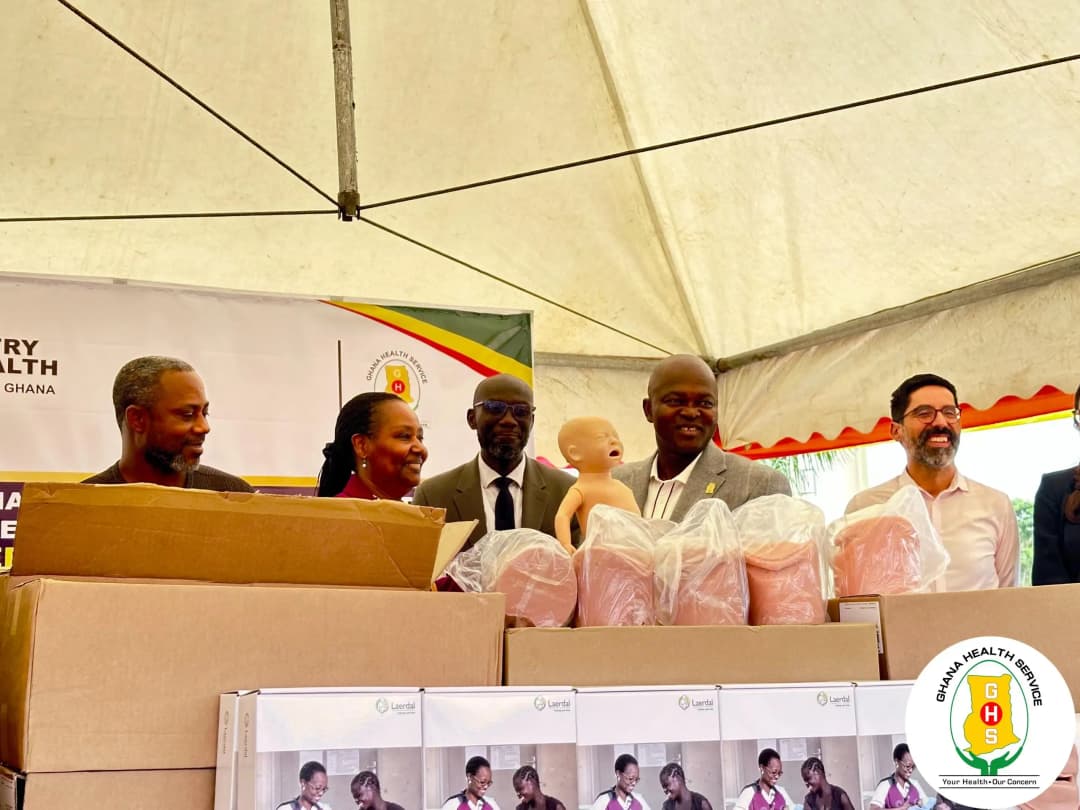
The Ghana Health Service (GHS) has received clinical training mannequins and other skills laboratory equipment valued at GH¢2.88 million from the United Nations Children's Fund (UNICEF) and the Government of Canada to strengthen the capacity of healthcare workers to manage maternal and child health emergencies.
The equipment was presented at a handing-over ceremony at the GHS Headquarters, Pantang, as part of the five-year Health System Innovation (HSI) Project, funded by Global Affairs Canada through UNICEF and implemented in the Ashanti Region since 2022.
The donation is expected to support the establishment and strengthening of clinical skills laboratories for the practical, on-site training of healthcare workers, particularly in the management of obstetric and neonatal emergencies.
Receiving the equipment, the Director-General of the Ghana Health Service, Dr. Samuel Kaba Akoriyea, described the occasion as an important milestone in the Service's efforts to strengthen emergency healthcare delivery under the Free Primary Healthcare programme.
He noted that the mannequins would provide healthcare workers with practical opportunities to acquire and improve life-saving skills, particularly those required during home visits and community-level service delivery.
According to him, strengthening the capacity of frontline healthcare workers to respond effectively to emergencies would contribute to improved patient outcomes and help address systemic challenges in emergency healthcare delivery, including the No Bed Syndrome.
He expressed appreciation to UNICEF and Global Affairs Canada for the support and urged the media to highlight the interventions being undertaken by the Government and its partners to reduce the country's disease burden and improve emergency healthcare services.
The Health System Innovation Project seeks to establish high-performing, efficient and sustainable health systems capable of delivering gender-responsive reproductive, maternal, newborn, child and adolescent health and nutrition (RMNCAH&N) services through innovative approaches.
Initially implemented in 20 districts, the project has been extended to cover all 43 districts in the Ashanti Region in its final phase to strengthen health systems and structures for improved maternal and child health outcomes, with particular attention to gender responsiveness.
Although originally scheduled to end in September 2026, the five-year project has been extended to September 2027.
Speaking for UNICEF Ghana, Dr. Manuel Dewez highlighted the continuing concern about maternal mortality in Ghana, noting that approximately eight women die daily from pregnancy-related complications.
He, therefore, underscored the importance of strengthening the key building blocks of the health system, including leadership, sustainable health financing and a well-equipped healthcare workforce.
He noted that the project had contributed to progress in maternal health in the Ashanti Region and stressed the importance of equipping healthcare professionals with the competencies and practical skills required to perform emergency procedures, including resuscitation of new borns.
The Head of Cooperation at the Canadian High Commission, representing Global Affairs Canada, Nduwimana Françoise, commended the Government of Ghana, the Ghana Health Service and its regional leadership for their efforts to improve maternal and child health.
She also acknowledged the participation and commitment of Members of Parliament and commended the Ashanti Regional Director of Health Services for his dedication to the project.
She emphasised the importance of evidence-based decision-making in strengthening healthcare systems and reaffirmed Canada's commitment to supporting Ghana's efforts to improve maternal and child health outcomes. She expressed the hope that the donated equipment would consolidate the gains made through the project and contribute to stronger partnerships between the two countries.
The Ashanti Regional Director of Health Services, Dr. Fred Adomako Boateng, highlighted the impact of the project's clinical mentorship programme, describing it as an important intervention that had provided valuable insights into the challenges confronting healthcare delivery.
Drawing on experiences and feedback from mentors, mentees, healthcare professionals, researchers, the Ministry of Health and other stakeholders, he noted that the programme had yielded encouraging results and was contributing to improvements in clinical practice and the quality of care.
He expressed confidence that sustained mentorship and practical skills development would contribute to reducing preventable maternal and child deaths in the region.
The Chairman of Parliament's Select Committee on Health, Dr. Kurt Mark Nawaane, speaking on behalf of the parliamentarians present, expressed appreciation to UNICEF and Global Affairs Canada for the intervention. He reiterated Parliament's commitment to supporting efforts to improve healthcare delivery and observed that increased domestic financing for health, alongside partner support, was important to achieving Universal Health Coverage by 2030.
The donated equipment, valued at GH¢2,878,489, comprises childbirth simulators, birthing stages trainers, postpartum haemorrhage trainers, episiotomy suture trainers, neonatal and breastfeeding simulators, as well as non-pneumatic anti-shock garments.
The equipment is expected to strengthen practical training in the management of childbirth complications, postpartum haemorrhage, neonatal emergencies and other conditions requiring prompt clinical intervention.