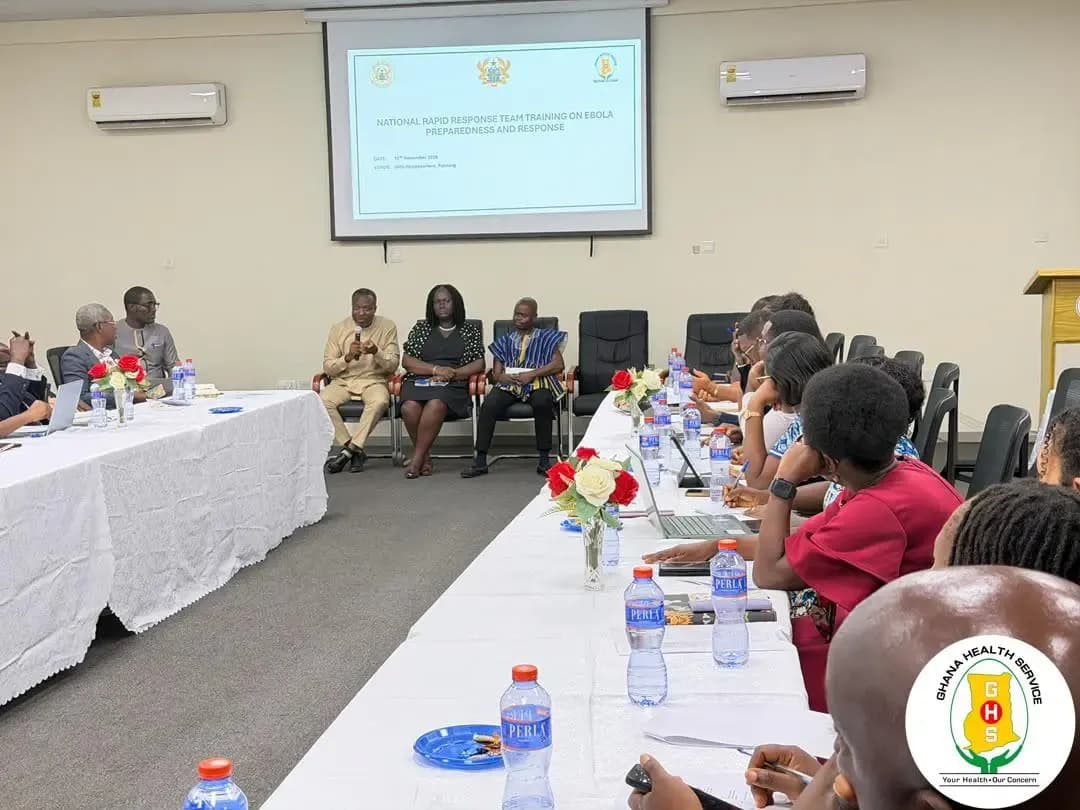
The Service has held a National Rapid Response Team (RRT) Training on Ebola Preparedness and Response to strengthen Ghana’s readiness for a potential Ebola outbreak.
The training brought together a multisectoral team to enhance response coordination, clarify roles and responsibilities and strengthen readiness for rapid activation and deployment.
The meeting focused on strengthening key areas of Ebola preparedness and response including Coordination, Public Health Emergency Operations Centre (PHEOC), Laboratory Capacity, Points of Entry, Risk and Crisis Communication, Case Management, Logistics, Surveillance, Contact Tracing, Infection Prevention and Control (IPC), and Community Engagement.
It also sought to address gaps identified through the WHO readiness assessment to ensure a coordinated, timely and safe response to any potential outbreak.
In his welcome address, the Director of Public Health Division of GHS, Dr. Franklin Asiedu-Bekoe, called for stronger preparedness and coordinated response efforts to enhance Ghana’s readiness for a possible Ebola outbreak.Drawing lessons from the challenges encountered during the 2015 response, he stressed the need to move beyond training to ensure that trained personnel are available and ready for immediate deployment.
He identified early case detection, sample collection and transportation, private healthcare facility readiness, and infection prevention and control as critical areas requiring urgent attention.
He further called for strengthened coordination among thematic teams, validation of response personnel, adequate availability of PPE and clearly defined roles and responsibilities.
In a presentation on coordination structures, activation procedures and Rapid Response Teams, Head of the National Public Health Emergency Operations Centre (PHEOC), Dr. Lawrence Lartey, highlighted the importance of effective coordination, clear lines of responsibility and proper documentation in managing public health emergencies.
He explained that the PHEOC provides the overall coordination platform for bringing together relevant institutions, resources and information, while the Incident Management System (IMS) provides a structured approach to managing an emergency under an appointed Incident Manager. The Rapid Response Teams, on the other hand, undertake operational activities, field investigations and reporting at the national, regional and district levels.
Dr. Lartey further explained that the response process begins with the notification of a suspected public health event, followed by surveillance reporting and a multidisciplinary risk assessment to determine the appropriate level of response and the need for activation of the Emergency Operations Centre. He urged stakeholders to understand their respective roles and work collaboratively within the national coordination framework.
The training also featured thematic discussions on safe care, safe and dignified burial, transport, logistics, finance, partnerships, and Risk Communication and Community Engagement (RCCE).
Discussions focused on strengthening first-contact screening, staff competence in infection prevention and control, access to psychosocial support, family communication, availability of burial team equipment, and the timely deployment of personnel, vehicles, supplies and approved resources. Participants also examined operational gaps, referral systems and response pathways to ensure timely and effective action in the event of a suspected Ebola case.
The Rapid Response Team is made up of representatives from the Ghana Health Service (GHS), United States Centers for Disease Control and Prevention (U.S.CDC), World Health Organisation (WHO), Ghana Infectious Disease Center(GIDC), the Korle Bu Infectious Disease Center (KIDC), National Disaster Management Organisation (NADMO), National Ambulance Service (NAS) , Environmental Protection Agency (EPA), Academia, Mortuaries and Funeral Facilities Agency and among others.