
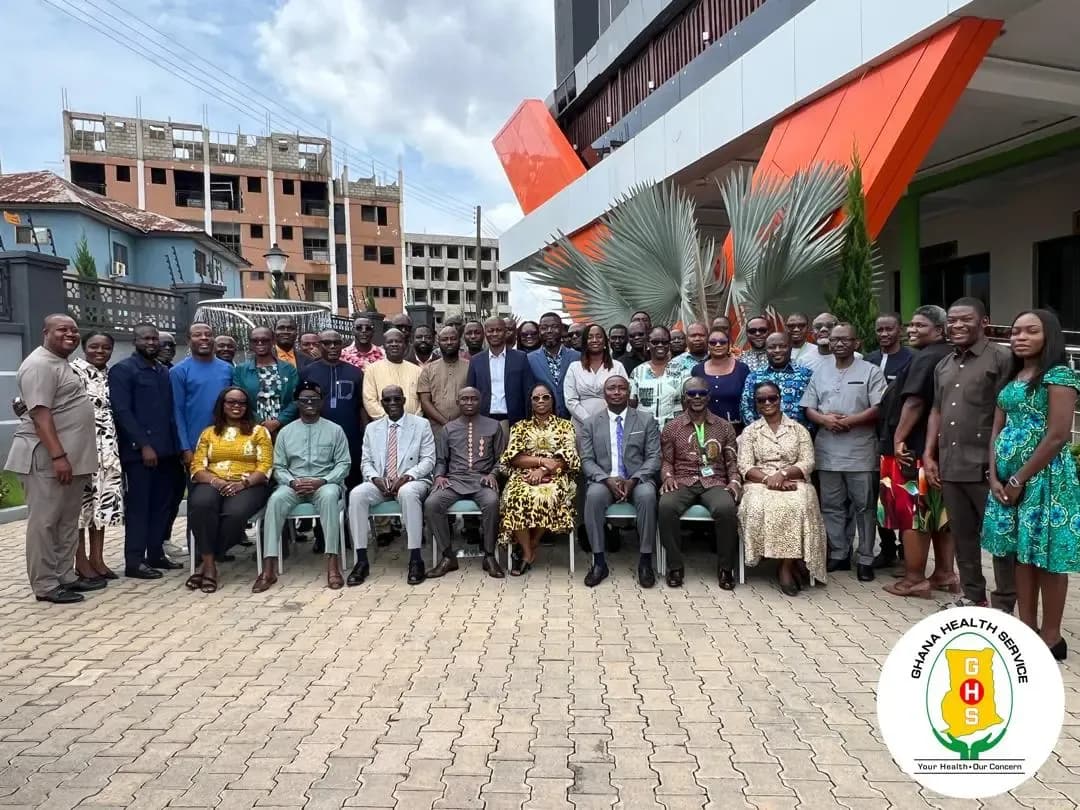
The Deputy Director-General of the Ghana Health Service, Dr. Caroline Reindorf Amissah, has called on Programme Managers, Deputy Directors of Public Health (DDPHs) and Deputy Directors of Clinical Care (DDCCs) to move beyond working in silos and strengthen collaboration between public health and clinical care to improve health outcomes.
She said the Ghana Health Service could not effectively respond to health challenges when public health and clinical care operated as parallel structures, stressing that the Service was established to provide a unified health service with a shared responsibility to deliver better outcomes for the people of Ghana.
Dr. Reindorf Amissah made the call in Koforidua during a two-day Health Security and Programme Management meeting organised by the Public Health Division for Programme Managers, DDPHs and DDCCs from across the country.
Held under the theme, “One Ghana Health Service: Strengthening the Integration of Public Health and Clinical Care for Improved Health Outcomes,” the meeting sought to strengthen collaboration and integrate public health and clinical care activities across the regions.
The Deputy Director-General said public health could not be effectively delivered without clinical care, just as clinical care could not operate without understanding what was happening within communities. Using cholera as an example, she explained that managing patients in health facilities was only one part of the response, as teams must also identify the source of Vibrio cholerae, investigate possible transmission routes and take action to interrupt further spread. This, she said, required surveillance teams, laboratories, emergency responders and clinicians to work together.
She said the same approach was required across programmes including HIV, tuberculosis, malaria, immunisation and non-communicable diseases, where prevention, detection, treatment, referral and follow-up were interconnected.
Dr. Reindorf Amissah also called for closer use of health information to drive joint action, noting that systems such as DHIMS, SORMAS and IDSR provide a common picture of the country's health situation.
“Data is only valuable when it drives timely joint action,” she said, urging public health and clinical care teams at the regional level to review data together, jointly identify challenges and develop coordinated responses.
She further challenged participants to return to their regions and work differently, stressing that integration would not be achieved simply because the meeting had been held.
“Something must change,” she said, urging every Programme Manager, DDPH and DDCC to leave the meeting with at least one concrete commitment to work with a colleague from the other side of the divide, share information routinely and coordinate field activities.
She also called for practical regional action plans to be developed as one of the key outcomes of the meeting.
Welcoming participants on behalf of the Eastern Regional Director of Health Services, Dr. Damien Punguyire, the Deputy Director of Public Health at the Eastern Regional Health Directorate, Dr. Moses Barima Djimatey, said stronger collaboration was essential to improving population health and disease prevention. He noted that public health units located within hospitals sometimes operated with limited oversight from hospital management, despite their role in areas such as disease surveillance, HIV and tuberculosis control.
Dr. Djimatey said hospital management needed to take greater responsibility for ensuring that institutional public health functions were properly supervised and supported. He called for disease surveillance, outbreak detection and outbreak management to be treated as integral parts of hospital operations rather than as additional responsibilities for individual disease control officers or clinicians.
He said the Eastern Region was working towards establishing a common platform that would bring District Directors of Health Services and Medical Superintendents together to strengthen coordination between district and institutional health services.
In his remarks, the Director of Public Health Division, Dr. Franklin Asiedu Bekoe, indicated that the meeting was organised after previous programme management engagements identified gaps in coordination between public health and clinical care.
Referring to recent public health emergencies including COVID-19, cholera, mpox and meningitis,
Dr. Bekoe said effective response required physicians, laboratory scientists, surveillance officers and other responders to work together.
He cited tuberculosis screening at OPDs, HIV testing and linkage to care, and maternal mortality as examples of issues that cannot be addressed solely as public health or clinical care concerns.
He therefore called for the public health and clinical care dichotomy to be reduced at all levels of the Service, with success ultimately measured by effective collaboration across all 16 regions.
In a related remarks, the Director of the Institutional Care Division, Dr. Lawrence Ofori Boadu explained that while clinical care focuses on services delivered within institutions, public health departments and units also operate within those same institutions. He said separating the two functions could result in parallel activities and weaken integrated care.
He added that specialised services including nursing, pharmacy, health promotion and surveillance must work together to strengthen patient care and health outcomes and further stressed that every public health activity has a role for clinical care, just as every clinical care activity has a role for public health, and said the meeting provided an opportunity for participants to better understand their respective roles and how they intersect.
The Ashanti Regional Director of Health Services, Dr. Fred Adomako Boateng, in a presentation on strengthening collaboration, focused on the structures and reporting relationships within the Service and how they could support greater integration between public health and clinical care.
He said the DDPH and DDCC should work towards common goals and objectives and proposed shared leadership as an important approach to strengthening collaboration at the regional and district levels.
Dr. Adomako Boateng identified integrated assessments, joint performance management, peer reviews and integrated supportive supervision as practical mechanisms for bringing the two functions together.
He explained that issues such as maternal mortality and malaria require both community-level and facility-level interventions and should therefore be jointly assessed by public health and clinical care teams.
He also called for common denominators and shared analysis in performance reviews so that clinical services are fully reflected in assessments of health service delivery.
According to him, supportive supervision should similarly be integrated, with public health and clinical care teams bringing their respective gaps to a common platform for discussion and action.
He said the ultimate objective was to establish collaboration between public health and clinical care across all 16 regions, supported by shared leadership, joint planning and a common understanding of responsibilities.
In a solidarity message on behalf of the JHPIEGO Country Director, Ms. Samuelina Arthur, reaffirmed the organisation’s support for efforts to strengthen public health emergency preparedness and response.
She noted that the Global Health Security Project, implemented by RISE and funded by the U.S. Department of State, supports the GHS in areas including disease surveillance, laboratory systems, case management, infection prevention and control, and oxygen capacity in selected facilities.
She expressed support for stronger collaboration between the GHS and its partners to improve emergency preparedness, response coordination and the capacity to prevent, detect and respond to public health threats.
The meeting forms part of the Service’s efforts to integrate activities across divisions and regions and ensure a more coordinated approach to health service delivery and improved health outcomes.