
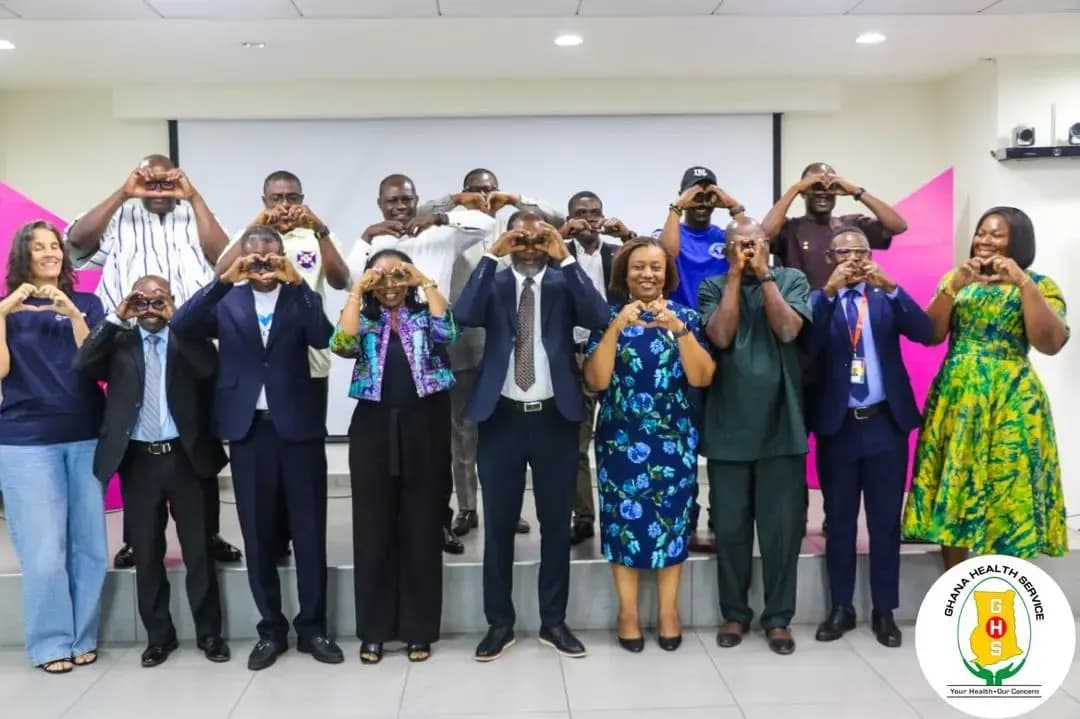
The Ministry of Health (MoH), in collaboration with the Ghana Health Service (GHS), international non-governmental organizations, and development partners, officially commemorated the media launch of World Sight Day 2026.
Speaking on behalf of the Minister for Health, Hon. Kwabena Mintah Akandoh, Dr. Ignatius Awinibuno highlighted the crucial need to address avoidable visual impairment and integrate eye care into routine primary health services across the country. He stated that this year’s celebration aligns with the global theme, "Love Your Eyes," while Ghana commemorated the event under the national theme: "Eye Care for All: Integrating Vision into Primary Health Care."
Delivering remarks on behalf of the Director-General, the Deputy Director-General Dr. Caroline Reindorf Amissah emphasized the urgency of addressing national eye health challenges, noting that approximately 67% to 68% of affected individuals in Ghana currently lack access to eye care services.
Pointing out that these managed conditions disproportionately burden rural communities compared to urban areas, she stressed that maximizing preventive and promotive primary healthcare is essential to stop preventable eye diseases like glaucoma.
To overcome these barriers, the GHS called for building capacity among frontline health workers for early detection and timely specialist referrals, strengthening health education, and encouraging routine vision screenings especially for children, older adults, and vulnerable groups.
Dr. Reindorf Amissah therefore urged all stakeholders to translate partnerships into stronger healthcare systems, noting that protecting sight safeguards education, livelihoods, independence, and the nation's future.
Providing a comprehensive technical presentation, Dr. Hornametor Afake, Head of the Eye Care Unit within the Institutional Care Division, contextualized the scale of the crisis using global and national data.
He noted that World Sight Day celebrated on the second Thursday of October highlights eye health not just as a public health priority, but as a critical development issue.
Globally, 2.2 billion people suffer from vision impairment or blindness, 50% of which is preventable or unaddressed resulting in over $411 billion in lost economic productivity annually.
Dr. Afake revealed that in Ghana, an estimated 16% of the population (~5.5 million people) suffer from eye conditions, with a national blindness prevalence of 0.74% and severe visual impairment at 1.07%.
This means approximately 234,000 Ghanaians are completely blind, with cataracts being the leading cause of blindness in the country at 54.8% (~140,000 people), followed by glaucoma at 19.4% (~50,000 people).
Highlighting findings from the 2023 Ghana Eye Health System Assessment, Dr. Afake shared that Ghana scored 2.3 out of 4.0 overall across health system pillars, with Financing scoring the lowest at 1.7, emphasizing a severe funding gap. He further pointed out a severe maldistribution of eye care personnel: over 70% of Ghana's 168 ophthalmologists, 750 optometrists, 900 ophthalmic nurses, and 800 opticians are concentrated in Greater Accra and Ashanti Regions, leaving four regions completely without a resident ophthalmologist.
Dr. Afake, however, highlighted ongoing advocacy to include children's prescription glasses under the National Health Insurance Scheme (NHIS) benefit package, reduce import duties on optical wear, and expand NHIS coverage for glaucoma medications.
Adding to the call for national action, a representative from the International NGOs in Eye Health (NGO Eye Forum) emphasized that good vision is a fundamental right that affects every aspect of human life determining whether a child reaches their full potential in school, whether an adult can work to support their family, and whether an elderly person can remain independent and connected.
He noted that international partners do not seek to create parallel systems, while reaffirming their commitment to aligning with and strengthening Ghana's national eye health systems.
The forum stressed the necessity of moving beyond temporary projects toward sustainable systems, shifting from isolated interventions to coordinated action, and ensuring equitable access so that no child is unable to see the classroom board, no adult loses their livelihood to untreated eye conditions, and no citizen suffers from avoidable blindness simply due to financial or geographical barriers.
Concluding the address, a passionate call to action was extended to all Ghanaians and stakeholders to move beyond raising awareness toward active, renewed commitment by investing in primary eye care and bringing services directly into local communities, in addition to prioritizing regular eye checks.